Wimba Voice Tools - evolving a product into a product suite
COMPANY
Wimba
ROLE
Director of Product and Design
FOCUS
Product design
Product management
Product strategy
User research
I joined Wimba, an edtech startup, in a head of design role after a few years of self-study on UX/UI and graphic design. Although I also designed logos, collateral and the website, this turned out to be my first product management role.
One of their leading products was the Wimba Voice Board. It worked like a message board, but allowed teachers and students to post audio and text. It was aimed at foreign-language teaching: a teacher could record something and students would record themselves repeating it.


The first steps I took were to improve the look of the app, and improve usability by eliminating misleading graphics in front of un-expandable nodes in the content tree, and by showing the contents of a node in a second pane rather than relying on a hard-to-discover double-click function.
We also solved a major usability issue for teachers. Previously they were not able to reuse any content in a board - if a teacher recorded exercises for a course, the only way to get the same exercises in a new board was to rerecord them there. We introduced an import/export feature that solved this problem and paved the way for teachers to share or even sell audio content. An HTML publish option also allowed them to use content outside the confines of the Java-based app.
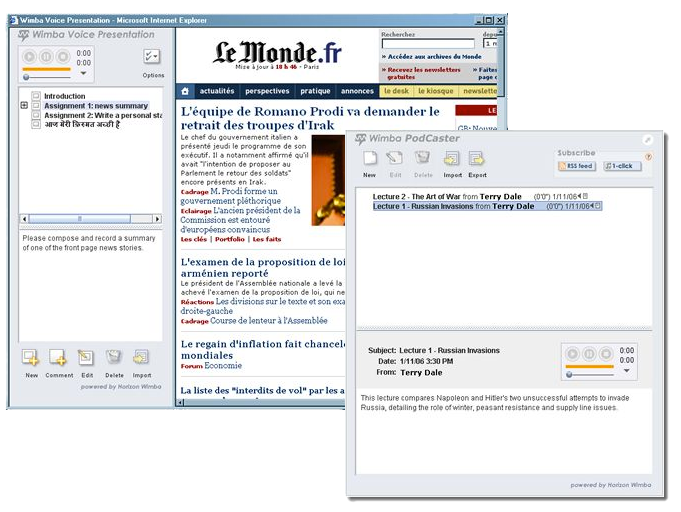

From there, I leveraged the core functionality of the board to create multiple new products. Wimba Voice Presentation paired the audio and text functionality with a URL that was loaded in a separate pane, allowing students or teachers to create a narrated slideshow. Wimba PodCaster built a podcast-ready RSS feed on the back end and allowed users to subscribe.
Thanks to the additional products, we expanded the offering into a Wimba Voice Tools Suite and sold it at a higher price point.